What does the Bible say about food?
The Bible's teaching on food moves through several distinct layers. At creation, humanity received only plants and fruit; after the flood, God expanded the diet to include all moving creatures while forbidding blood. The Mosaic law then introduced detailed clean and unclean animal categories, with pork among the explicitly forbidden foods, and an eschatological oracle in Isaiah still condemns pig-eating. The Jerusalem Council carried forward the blood prohibition to Gentile believers and added three other abstentions, but notably omitted the full Leviticus 11 animal list. Whether those animal laws bind people outside the Sinai covenant is the central unresolved tension: the New Testament texts most often cited as revocations each address something else, and no same-authority text explicitly cancels the Leviticus 11 commands. On alcohol, the evidence consistently permits moderate drinking while condemning drunkenness. On food sacrificed to idols, the texts genuinely pull in opposite directions and the study cannot resolve them.
Assembled from 11 gated engine answers, every verse reference below comes from that research, verified word-for-word. How the method works →
From the Garden to the Flood: A Changing Diet
The Bible's story of food begins with a specific and narrow grant. At creation, God addressed humanity directly: "Behold, I have given you every herb yielding seed, which is on the surface of all the earth, and every tree, which bears fruit yielding seed. It will be your food" (Genesis 1:29). The same chapter extends a parallel provision to animals, giving them "every green herb for food" (Genesis 1:30). The picture is one of a shared, plant-based world.
That arrangement did not last. After the flood, God spoke again with equal directness, and the scope of permitted food expanded dramatically: "Every moving thing that lives will be food for you. As I gave you the green herb, I have given everything to you" (Genesis 9:3). The phrase "as I gave you the green herb" is not incidental. It marks the contrast deliberately, pointing back to the earlier arrangement and announcing a change. One boundary remained, however, even within this expansion: "flesh with its life, that is, its blood, you shall not eat" (Genesis 9:4). The permission to eat animals came with a condition attached from the very beginning.
The pre-flood distinction between clean and unclean animals appears even before the dietary laws of Sinai. Noah was instructed to take seven pairs of every clean animal and two of every unclean one (Genesis 7:2), and after the flood he offered burnt offerings from the clean animals (Genesis 8:20). The categories existed before they were codified.
The Mosaic Law: Clean, Unclean, and the Rationale Behind Them
At Sinai, God gave Israel a detailed system for distinguishing permitted from forbidden foods. The opening of Leviticus 11 frames it as divine speech addressed to "the children of Israel" (Leviticus 11:1-2), and the criteria are precise: land animals must both part the hoof and chew the cud to be clean. The pig fails the second test and is therefore forbidden: "The pig, because it has a split hoof, and is cloven-footed, but doesn't chew the cud, is unclean to you. You shall not eat their meat" (Leviticus 11:7-8). Deuteronomy 14:8 repeats the same prohibition without modification.
The rationale given is not hygienic or cultural but theological. The closing verses of Leviticus 11 ground the entire system in God's own holiness: "For I am Yahweh your God. Sanctify yourselves therefore, and be holy; for I am holy" (Leviticus 11:44). The law's purpose is to "make a distinction between the unclean and the clean, and between the living thing that may be eaten and the living thing that may not be eaten" (Leviticus 11:46-47). Holiness, in this framing, is expressed through the daily act of choosing what to eat.
The blood prohibition, already stated at Genesis 9:4, is reinforced with particular force in Leviticus 17. There it covers not only Israelites but "the strangers who live as foreigners among them" (Leviticus 17:10), and the reason given is that "the life of the flesh is in the blood" and that blood has been given for atonement (Leviticus 17:11). The prohibition reaches beyond the covenant community by its own terms.
Isaiah's Eschatological Warning
One of the most striking features of the food-law material is that it does not stay confined to the Mosaic period. In an oracle that looks toward a future gathering of all nations, God speaks through Isaiah in language that echoes Leviticus: "Those who sanctify themselves and purify themselves to go to the gardens, following one in the middle, eating pig's meat, abominable things, and the mouse, they shall come to an end together, says Yahweh" (Isaiah 66:17). The condemnation of pig-eating appears here in an end-times context, spoken by God, without any explicit limitation to Israel alone. The following verse announces that God will "gather all nations and languages" (Isaiah 66:18). The oracle does not specify whether its audience is Israel only or all peoples, and that ambiguity is part of what makes the question of the food laws' scope genuinely difficult.
The New Testament Texts and What They Actually Address
Several New Testament passages are regularly read as modifying or abolishing the Leviticus 11 food laws, and each deserves careful attention to what it actually says.
The dispute in Mark 7 and Matthew 15 concerns hand-washing before meals, a tradition of the elders, not a Mosaic command. The Pharisees ask why Jesus' disciples eat "with unwashed hands" (Mark 7:5). Jesus' response addresses the question of what defiles a person morally, and the narrator adds the aside that his words had the effect of "making all foods clean" (Mark 7:19). That parenthetical gloss is the narrator's editorial comment, not a direct statement by Jesus about the Leviticus 11 animal categories. The weight of the evidence points toward the dispute being about ritual hand-washing, and whether the narrator's comment reaches the clean and unclean animal distinctions requires an inference the text does not state explicitly.
Peter's vision in Acts 10 is similarly specific in its own interpretation. Peter sees a sheet of animals and hears a voice saying "Rise, Peter, kill and eat!" (Acts 10:13). He refuses on the grounds that he has never eaten anything unclean. But when Peter himself explains the vision's meaning, he says nothing about food: "God has shown me that I shouldn't call any man unholy or unclean" (Acts 10:28). The vision's subject, by Peter's own account, was the acceptance of Gentile people, not the revision of dietary categories. The conclusion of the episode is that "God has also granted to the Gentiles repentance to life" (Acts 11:18).
The apostolic letters add further texture. Paul writes in Romans 14:14 that "nothing is unclean of itself," and in Romans 14:20 that "all things indeed are clean." Colossians 2:16-17 tells believers not to let anyone judge them "in eating or drinking," describing such observances as "a shadow of the things to come." First Timothy 4:4 states that "every creature of God is good, and nothing is to be rejected if it is received with thanksgiving." These are genuine statements pointing toward food freedom. They are, however, apostolic letters, and they do not explicitly state that they are overriding the Leviticus 11 commands. The tension between these texts and the standing Tier 1 commands is real, and the study cannot resolve it.
The Jerusalem Council's Ruling for Gentile Believers
The Jerusalem Council in Acts 15 provides the clearest direct ruling on what Gentile believers were required to observe. The council's letter, confirmed three times in the text (Acts 15:20, 15:29, and 21:25), lists four requirements: abstain from food polluted by idols, from blood, from meat from strangled animals, and from sexual immorality. The letter states that the Holy Spirit and the council agreed to "lay no greater burden on you than these necessary things" (Acts 15:28-29).
Two things stand out. First, the prohibition on blood is explicitly carried forward to Gentile believers, connecting back to the pre-Sinai command of Genesis 9:4 and the Leviticus 17 prohibition that already extended to resident foreigners. The blood prohibition has the clearest cross-covenant grounding of any food rule in the text. Second, the council's list does not include the full Leviticus 11 animal categories. It does not explicitly revoke them either. The omission is noted by the research but not resolved by any text.
Food Sacrificed to Idols: A Genuine Tension
On the question of food sacrificed to idols, the texts pull in genuinely opposite directions, and this study cannot resolve them.
Paul, writing to Corinth, permits eating whatever is sold in the market without asking questions (1 Corinthians 10:25), and eating whatever is served at a private meal from an unbeliever (1 Corinthians 10:27). His reasoning is that "no idol is anything in the world" (1 Corinthians 8:4). He draws a firm line only at eating in an idol's temple, which he calls fellowship with demons (1 Corinthians 10:20-21), and at eating when someone explicitly identifies the food as idol-meat in a way that would harm a weaker conscience (1 Corinthians 10:28).
The risen Jesus, addressing the assembly at Pergamum in Revelation 2:14, says "I have a few things against you, because you have there some who hold the teaching of Balaam, who taught Balak to throw a stumbling block before the children of Israel, to eat things sacrificed to idols." The same rebuke appears at Thyatira (Revelation 2:20). Both passages use the same Greek word for idol-food that Paul uses. Whether Jesus' rebuke is limited to the cultic-meal context that Paul also forbids, or extends to the market-purchase and private-dinner contexts Paul permits, the text does not say. Both speakers are addressing the same food, and the text does not state which context governs the other.
Alcohol: Permission and Its Limits
On alcohol, the evidence consistently points in one direction without being a single explicit statement. No text at any level issues a universal prohibition on drinking. Deuteronomy 14:26 permits the purchase of "wine or strong drink" as part of rejoicing before God. Psalms 104:15 describes wine as something that "makes the heart of man glad." Jesus produced wine at a wedding in Cana (John 2:9, 11) and distributed wine at the last supper, saying "all of you drink it" (Matthew 26:27). Paul advises Timothy to "use a little wine for your stomach's sake" (1 Timothy 5:23).
Specific restrictions exist for specific roles: priests were forbidden wine before entering the Tent of Meeting (Leviticus 10:9), and Nazirites abstained for the duration of their vow (Numbers 6:3), after which they were permitted to drink again (Numbers 6:20). These are role-specific, not universal.
What is universal and consistent across the texts is the condemnation of drunkenness. Proverbs 23:29-32 describes the end of those who "stay long at the wine." Ephesians 5:18 contrasts being "drunken with wine" with being "filled with the Spirit." Galatians 5:21 lists drunkenness among the works that exclude from God's kingdom. The weight of the evidence points toward moderate drinking being permitted while drunkenness is condemned across all tiers of the text.
What Remains Open
Several questions the research raises are not resolved by the texts themselves, and honesty requires naming them.
The most significant is whether the Leviticus 11 animal prohibitions bind those who were never party to the Sinai covenant. Leviticus 11 addresses "the children of Israel," but its rationale appeals to God's own holiness without limiting that holiness to one people. Isaiah 66:17 condemns pig-eating in an eschatological oracle without specifying its audience as Israel only. The Jerusalem Council's ruling for Gentiles omits the Leviticus 11 animal categories but does not explicitly cancel them. No same-authority text resolves this in either direction.
The meaning of Mark 7:19's "making all foods clean" remains genuinely contested. The phrase appears in a hand-washing dispute, and whether it reaches the Leviticus 11 distinctions is an inference, not a direct statement.
The tension between Paul's permission to eat idol-food in market and private-meal contexts and Jesus' rebuke of idol-food eating in Revelation 2 is not resolved by any text that specifies which context governs.
These are not failures of the text to be corrected by confident interpretation. They are places where the text itself leaves the question open, and where the honest reader must sit with the unresolved tension.
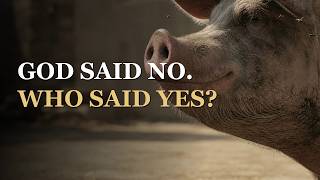 Watch the video on YouTubeWhat Does the Bible Say About Eating PORK?
The questions behind this article
Every question above has a complete analysis: each verse weighed, ranked by who is speaking, with both sides laid out where the text is contested. What Does the Bible Say About Food? collects all 11, and one is free to read.
See the pack, $8 →Assembled, never authored: every substantive claim traces to a tagged, gated answer, and contested questions stay contested in the prose.